
Footprint Optimization
Utility company redefines DC footprint to improve safety, lower cost, and support growth.
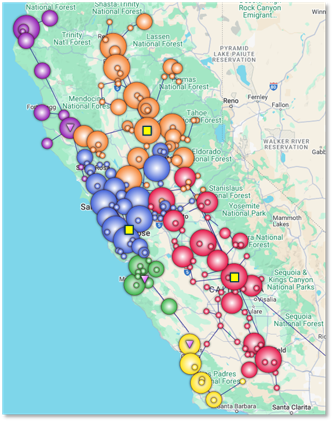
A utility company partnered with SCPI to redesign an aging, overloaded DC network that was creating safety risks, driving excessive inter-facility transfers, and inflating storage costs across the state. SCPI modeled three DC configurations and five fulfillment models — stress-testing each for growth, serviceability, and scalability — including center-of-gravity analysis, co-location impacts, and a full cash flow review.
The recommended plan saw reduced inventory transfers, minimized distribution space, and large gains in annual cash flow benefit.

Challenge
- Aging and overloaded DCs created safety risks, inefficient transfers, and excess storage costs.
- The company needed a right-sized, future-ready network that could support service needs, reduce logistics complexity, and eliminate waste.

Approach
- Evaluated three DC configurations and five fulfillment models against space, inventory, and service requirements.
- Stress-tested each scenario for growth, serviceability, and scalability to right-size the network.

Results
- 35% of inventory transfers eliminated.
- Distribution space reduction by 17-43%.
- $20M annual cash flow benefit.